Tom Cruise works as the eponymous hero, Jack Reacher, unless you've read the books.
Reacher,
the character, has many distinguishing characteristics. A former Army
Military Police Major, commander of an elite special investigations
unit, is out of the service and lives deliberately and compulsively off
the grid. No address, no email, no cell phone, no job (unless he needs
money). No car, no apartment or home. He travels by bus, and carries no
luggage and no weapons. He has no drivers license and no credit cards.
He does not even use laundry services, he wears clothes until they need
changing then picks up more from a Goodwill store. He is personally
disciplined and highly observant, he has a remarkable memory.
You do not get in touch with Reacher, it is all but impossible. In the
novel series, Reacher travels around somewhat aimlessly and simply finds
himself in the middle of criminal activity. Many times the activity is a
result of or related to his time in the Army. He uses pay phones and
pocket change and borrows things, cars, guns as he needs them, usually
from someone he's beaten to a pulp.
This is all pretty much consistent with Cruise's portrayal.
The glaring differences, and I will cite the two I saw immediately are important.
In
the series, Jack Reacher is six foot five and two hundred fifty
muscular pounds. His size plays a significant role in the books both as a
plus and an occasional hindrance. He also is very, very soft spoken, as
if his words were expensive and hard to replace. Short on cash? More
than once he's staked out and single handedly ripped off a drug dealer's
stash of cash.
He is confident, yet not outwardly snarky or cocky. He simply doesn't do nonsense.
Cruise's
(much) slighter size was smoothed over in the movie by creative
editing. In the books, most of the battles Reacher finds himself in are
vicious and violent physical brawls where his size is crucial. There are
physics involved in barroom scraps where size definitely does matter.
A slighter, though fit and resourceful man simply can not hold up his
end for very long in a tussle with four or five burly, doped-up bikers.
Since the story in the movie was edited heavily, which is fine since
novels are much more detailed than movies, Cruise, also the film's
producer, fiddled with the physical fight scenes to add more dance-like
martial art than brute-force thug tactics.
This didn't really bother me too much, martial arts skills have saved
many a smaller actor in the last few decades. This is mostly mythical
though. A modestly skilled monster-sized brute is still going to come
out ahead most times in reality.
But okay.
Reacher's real asset though is his investigative prowess,
his ability to dismiss the noise and politics and pit-bull the available
information and minute details. In this particular story, based on 'One
Shot' the ninth tale in the current sixteen book series, Reacher is
bothered about the evidence in a mass shooting. There's too much of it.
It rings in his head like an extra note in a beloved song.
A generic city in Pennsylvania (in the movie, Indiana in the book) Shots
ring out, six of them, five people, seemingly random targets of
opportunity, fall dead.
The local cops arrive led by a detective named Emerson, played very capably by British actor David Oyelowo (who played alongside Matthew Macfadyen in the British Series MI5).
There is damning evidence at the scene, a spent cartridge, scuff marks, a
traffic cone, security camera footage of a white van and at the target end
of the scene the missed shot, captured perfectly intact in a liquid
(Soda dispensers in the movie, a fountain in the book) and the one piece
of evidence that locks the police quickly onto their suspect,
fingerprints on a quarter in the meter where the van was parked.
The suspect is found drugged and drunk in his home, his weapon, five
spent cartridges and the van in his garage. James Barr, former Army
sniper, current unemployed loser.
In custody and dried out, Barr
says nothing, at all. When asked to fill out a confession after being
confronted with the massive weight of the evidence against him, he
instead writes "Get Jack Reacher"
In Florida, arising from a rowdy tangle with a beautiful woman, Reacher hears the news report of Barr's arrest.
Back
in Penn/Indiana, the cops are trying to locate Reacher with absolutely
no luck at all. Barr has been beaten into a coma his first night in
lockup.
In walks Reacher.
He reveals little though, adamantly and repeatedly denying that he and Barr were ever friends.
He
meets with the young, ambitious and fortuitously pretty defense
attorney (and daughter of the prosecutor) who wants Reacher to testify on
Barr's behalf. Reacher cannot since he says he is not there to help
Barr, he's there to bury him. Reacher had investigated and caught Barr
after a very similar shooting in the Gulf war and because of politics,
was forced to not make an arrest. He had told Barr at the time that if
he ever heard his name in connection to any crime he would hunt him down
and end him.
This is not a spoiler, it's merely the clever, twisted setup covered pretty accurately in the first ten minutes of the movie.
Of course Reacher's keen analytic sense tells him something's not right about the overwhelming preponderance of evidence. "Why would he pay for parking?"
So predictably he ends up working with the pretty attorney who is only
trying to spare Barr from the seemingly inevitable needle.
What happens next in the movie expectedly and for the most part,
forgivably, strays a bit from the book. The book is detailed with
process and procedure, deduction and investigation. The movie simply
doesn't have that luxury of time. Also the books spend a lot of time
inside the quiet protagonists head. That just doesn't make compelling
cinematography.
It's a very good story either way, a bit different between the two, but not bad at all in either.
As
I've pointed out, it is hard to take a novel with all it's nuance, back
story, character building and internal thoughts and make a good film. I
enjoyed both the book and the movie. If I made any mistake at all it
was watching the movie the day after I finished the book. Too soon.
A little more time between the two and I wouldn't have been so critical and bothersome while I was watching it with my family.
"That's three major characters on the cutting room floor."
"The gun dealer is in Kentucky in the book."
"They're supposed to be Russian."
"The traffic cone is a big deal." (though in the movie it isn't)
"The real Reacher is never charmingly snarky or flirtatious."
But
like I said, the movie was good by itself. In Tom Clancy's 'The Hunt
for Red October' the movie ended completely differently than the book,
and I think both are great classics of that particular genre. I am not a
purist, I like a good movie just as well as a good book, even when they
stray from each other, as they must do.
I once attended a book signing by a reasonably successful series
novelist. He was asked if he would accept a movie offer for his books if
it meant lots of changes. His reply: "Hell yes! All the way to the bank
and back."
So who should have been cast as Jack Reacher? That's an easy one for me,
Jim Caviezel (Person of Interest (CBS)). It's pretty much the same
character already. In the TV series Caviezel's mysterious and powerful
John Resse (notice the initials) is ex-military, off the grid, a big,
strong, quiet guy. Disciplined, self aware, rigid in principle, fearless
and immediately imposing.
When I read the books, I'm on the tenth one now, that's the character I have in mind.
Should
there be a sequel, or prequel (Author Lee Child has made both of these
options available already) I'd love to see a cast change. Tom Cruise can
certainly put out a good movie, but he is simply not the best choice
for this particular role.
Aside from that I highly recommend the movie, and even more so the series of novels.

Showing posts with label movie. Show all posts
Showing posts with label movie. Show all posts
May 20, 2013

Mar 31, 2013
On DVD now: Zero Dark Thirty
We’d been eagerly awaiting this movie, so much hype and
controversy, who wouldn’t want to see it?
But here’s the problem.
It purports to be based on actual firsthand accounts of
actual events. That’s quite a burden. Rarely do actual firsthand accounts of
actual events make a good movie. ‘Based on a true story’ is much, much easier.
For those three or four of you that haven’t heard about this film,
it’s about the CIA's hunt for Osama Bin Laden. Spoiler alert, they find him and kill
him.
And that’s part of the difficulty, we already know most of
the story, and we certainly know how it ends, now, entertain us.
I swim often in the pool called ‘creative non-fiction’. I
write essays, some that have been published in actual books, that are based on
true stories but have been enhanced, embellished, to make the stories more
entertaining. Some of the stories I’ve
written have been almost entirely true, some contain only a tiny shard of a
real story.
Hint: If my story contains witty banter or engaging dialogue,
then that part is almost certainly manufactured, real people in real life don’t
talk like they do in print. Well, maybe I do, but nobody else does.
We in the business call this ‘creative non-fiction’ which is
code for ‘tall tale based thinly on fact.’
Life, real life, is rarely
interesting on its own merits, conversations and interactions. Even intense, important,
historical events are laced with great big heaps of nothing especially interesting happening.
Take D-Day. Most of the soldiers,
sailors and Marines that were involved in the monumental, unprecedented and enormous
invasion of Nazi occupied Europe spent months, months,
doing virtually nothing but waiting. Whenever we see a movie with that much
waiting around involved, the producers tend to skip over the enormous part, or
enhance it with a little comic relief, usually guys playing poker in the bowels
of a ship until a fight breaks out. Not that the card game and the fight didn’t
happen, it’s just not likely that that particular set of guys played cards and
started a fight, if those guys really existed in the first place.
But if you are going to make a
movie that says it is based on true, firsthand accounts, then your embellishment
options are limited by your stated fact-based, eye witnessed story.
In the case of Zero Dark Thirty,
this is exactly where the controversy came from.
We saw the ‘good guys’, the CIA,
physically torturing detainees. Water torture, sleep deprivation, culture-based
humiliation. In one scene a man is stripped naked in front of a woman, had a
dog collar and leash attached to his neck and was forced to crawl around in
front of her. In certain cultures this is about as bad as it can get. Not
necessarily for Americans and Europeans as I’ve seen lots of movies and been to
a few parties that included men being stripped naked in front of, and often by,
women and led around on a leash. You know what I’m talking about. But for some
cultures this sort of behavior is perceived as a bad thing.
There is nothing, nothing, in
this movie we haven’t seen depicted thousands of times before in fiction movies
and TV shows. So it’s not the actions themselves that caused the uproar, it’s
the fact that these things are now being presented as things that we, the good guys,
actually did to other humans.
Some of the same people that
cheered on the fictional Jack Bauer in ‘24’ as he opened up some horrendous
whoop-ass on alleged terrorists, or who absolutely delighted when Rambo or some
other fictional character meted out violent, absolute vengeance, single-handedly
as judge, jury and executioner, now find themselves protesting that sort of behavior.
It’s pure duplicity. We want our fictional heroes to do
horrific things, but not our real heroes. Torture is apparently okay as long as there’s
nothing actually at stake. However, in the real world, when real lives have
been lost and more real horror is threatened, it’s inhumane.
I’m not saying torture is okay. I admit mixed/flawed/inconsistent
emotions on the issue.
But this movie was dealing with first-hand accounts of things that many now perceive as atrocities.
So there’s vicious torture early on, though filtered through
the lens of hindsight and good intentions.
Ten years post-9/11 it is easy to Monday-morning quarterback
the actions of our government. The film makes certain tacit apologies through
facial expressions and muted conversations about mixed/evolving feelings of the
apparently repentant/regretful torturers
after a few years have passed and politics back home have evolved.
The film spans seven or eight years. There are huge gaps
where apparently very little actually happened. You know, like in real life.
So the movie skips ahead several years, several times. The
characters though, never age. I’m not even sure they even changed clothes during
these long blank periods.
The story follows a female CIA agent, Maya, who for
reasons we are never quite made aware of, is considered an expert in the hunt for
Bin Laden. According to her own words, Bin Laden is all she has worked on for entire
career, nothing else, since her recruitment out of high school. (This is
mentioned, but never really explained either.)
Maya pushes, begs, pleads, humiliates and strong-arms her
less-enthusiastic bosses, a career strategy that could only ever work in
government employment circles, and finally gets her way. A raid is ordered up,
the imperfect, wobbly, top-secret stealth helicopter prototypes are loaded up
and SEAL Team Six does the dirty needful.
There is no real ‘rest-of-the-story’ aspect to this film.
We don’t really learn anything new. There are no great reveals in this flick,
it is simply a story that we’ve all heard before, played out on the big screen.
Even the raid itself is not very revealing as it takes
place mostly in the dark. Shadows move from room to room, violent noises erupt around
every dark corner. The entire raid takes place on screen in either disorienting stroboscopic
bright flashes in otherwise pitch-black surroundings, or through that nauseating dim green
we have come to equate with the world as seen through night-vision goggles. If
this segment were security tape footage of a crime, no one would ever be
convicted of anything given the poor angles and low resolution. But it is done
as a shaky, fast-paced and erratic ‘as-if-you-were-there’ event which gives you
the feeling of very high tension.
The casting was excellent, as it didn’t overshadow the
film or the story. The story itself was rather shaky and skippy though. If this
were a work of fiction, it probably would not have received nearly a fraction
of the fanfare and acclaim that it did. There are too many plot holes, too many
assumptions required, and believe it or not, very little actual tension and
conflict.
Don’t get me wrong, I stayed engaged watching the story
play out, even though I knew exactly what would happen next. The very fact that
it was in fact, factual, was at the same time its greatest selling point and
also its biggest handicap.
Yeah, go ahead and watch it, it’s not as bad as you might
think, though it’s not as good as a little fictionalization could have made it.
Mar 17, 2013
On DVD Now: Life of Pi
We snapped this one up the weekend of its release on DVD.
For us, that’s unusual. Sure it won a bunch of awards, sure it was critically
acclaimed, but was it actually any good?
We gave it a shot.
First and foremost the opening several minutes could easily
be a presentation by the India
tourist bureau. The scenery, the architecture, the wildlife, the rich, vivid
colors were tremendously inviting.
I know a little about India
and the cultures there. You can tell that by the way I used the plural form of
'culture'. India
is a big-ass land mass. It boasts around a BILLION souls. That’s BILLION with a
‘B’. Three of them for every single American resident, legal and illegal. India is a land of wide diversity, rare is the stereotype that accurately spans the entire nation.
In the most recent iteration of my IT career, the last twelve or so years, I’ve had the good fortune to have known and worked with
scores of fine people from India.
Not a random scattering, admittedly, but scores of technically sharp, college
educated and mostly articulate-English-speaking people from India.
I’ve come to know a little about their cultures and their lives and have always
been fascinated and impressed.
Theirs is a rich and ancient story mix of adversity and
fortune, wealth and poverty. Their society is dotted with a wide variety of
gods and demons, stories that predate Christianity by thousands of years. Bizarre
tales that seem to us fantastic tall tales of magic and enchantment, betrayal
and power-lust that make the Greek and Roman gods seem tame and boring in
comparison.
My good friend and co-worker Ramesh once told me about the
elephant-headed god that the little statue on his dashboard represented. “He
clears obstacles.” He said to simplify the epic stories.
I admire Ramesh, he seems to personify many of the ideals
that I wish I could claim. He is a devoted husband, a doting father of a beautiful
little girl, a dutiful son himself, and a cautious, meticulous worker. He is
proud and patient. Whenever he is asked about his culture by any of us simple
Americans he smiles and explains it in a simple and thorough narrative. He
doesn’t take offense at our mistaken understandings, and does not correct us
boastfully or arrogantly. He is a humble and polite man, and quick with a joke.
Not unlike the movie’s main character, Pi.
In the movie, Pi, the adult version telling his life story,
explains to the inquisitive Canadian writer, how he and others can easily be both
Catholic and Hindu. “We get to feel guilt towards hundreds of gods, not just
one.” He says with a winking smile.
I loved the way Hinduism was interlaced into the movie’s
storyline, not proselytizing, rather explaining how the ancient religions that
are Hinduism are a very prominent part of the people, and how understanding a
little about the religion helps one better understand the people.
In evidence, the reluctance and conflict when Pi, stranded
aboard a lifeboat with a Bengal tiger, and early on by
an orangutan, a wounded zebra and a hyena, cannot justify killing any of the
animals, even when faced with starvation or the teeth and claws of the hungry
tiger itself. Upon clubbing a large fish to feed to the emaciated giant cat he
weeps with pain and screams apologies to the fish, at the same time praising
Vishnu for sending the fish to feed the tiger to keep the tiger from eating him.
By this point in the film you get it, you really do.
That’s how good a job the writers and screen adapters did their
job. You actually feel Pi’s pain for having to kill a fish to save his own life.
By now you know the crux of the story, Pi is raised by a
family that runs a zoo. They decide to move to North America,
so they load up all the animals into a Japanese freighter and they all set sail
across the pacific.
Then there’s a terrible storm. So for most of the rest of
the movie we have Pi and the Tiger in a battle of wits in a thirty-person
lifeboat.
What about the other animals I mentioned? Did you not read
the part about there being a hungry Bengal tiger aboard?
Sheesh, this ain’t no Disney cartoon where the lions and lambs sleep and play together.
I was glad to see that the animals, even though they were
almost entirely computer generated, were allowed to portray what they were,
wild animals, not cute, talking, fluffy toys. Pi is made to understand this
very thing by his father earlier in the story.
Without giving away the real twists and ending, I’ll just
say this, the tiger and Pi never, ever kiss and make up or become bosom
buddies. I was glad to see this; take that Gentle Ben, Tarzan, Daktari, Jungle
Jim, and Elsa the cuddly lioness in “Born Free”.
I’ve mentioned that the animals were mostly CGI’d. Which
leads me to the most stunning and pleasing aspects of the movie. The
cinematography.
There were many places in the film that were obviously CGI.
The animals tended to be a bit jerky at some points, their movements not fully
perfected. But what really stood out were the fantasy scenes. As delirium and
reality become harder for Pi to discriminate, we too, through absolutely vivid
and bright, rich, compelling graphics and detail, are often mesmerized by the
unearthly images before us. The brightly glowing jelly fish, the leaping great
whale, the tens of thousands of meerkats on the lush, lime-green floating
island, and more, much, much more. We don’t care whether it is real or
imagined, we just want it to be real, it is real, at least for a moment.
The imagery is not just interwoven into the overall story,
it is integral to the story. For the story itself is epic, fantasy-like and
surreal, not unlike the many small Hindu stories laid out earlier in the film.
The movie is bright, spectacular and in several places quite
funny. Though very dark, almost horrific at the core, Pi smiles, laughs and
jokes often about the agonizing turns of fate. Even devout Christians can enjoy
this movie, and would note the many similar story lines, not only of the boat
full of animals, but also by the Job-like spiraling suffering and the steadfastness and resolve
of Pi’s complex beliefs.
By the end of the film, the word I came up with was ‘Wow!’
I was entertained, thoroughly. I was not preached to, hit
over the head, or tricked into liking the movie. There were no A-list celebrities
at all, no one’s ruggedly handsome mug nor quaffed Hollywood
perfection to steal scenes and attention from the story itself.
The movie makes many points, mostly subtle, but the one I
came away with that stands out above the others is that it is not so important
what the characters in a story are, often they are merely symbols. What is
important are the life lessons learned form the stories, whether the story character
be a tiger, a talking snake, a human living in a fish, an elephant headed god,
these elements merely make the lesson more memorable, something even old Aesop
recognized. You certainly remember those talking, magical animal morality tales
don’t you?
What is important is making the story and the lessons
memorable, and “Life of Pi” certainly masters this.
Highly recommended!
Mar 14, 2012
On DVD Now: Hugo
I wasn’t exactly dying to watch this movie. I’d heard about it, seen previews, yawned. The fact that it won lots of snooty awards didn’t help.
But Saturday night came around and I was tired and sore from contorting myself most of the day trying to replace an almost-fits bathroom faucet. I hate plumbing, the outgoing part much more so than the incoming part, but I don’t really care at all for either. It’s all about fiddly parts. If you don’t have the exact right one, you’re doomed to use hammers, slip-wrenches and pliers. Knuckles will get busted, you will get damp, and there’s never any telling what that disgusting, soggy glob that just fell out of the trap is.
So I was not really picky. I’d scanned through the DISH-On-Demand offerings and couldn’t find anything better. Angel and Adam had mentioned wanting to see Hugo, I was indifferent, they won.
It didn’t help that the rental screen indicated that the movie was two hours and six minutes long. That’s about twenty more minutes than any movie should be.
But I was tired and sore, and had a box of wine beside me to take off some of the edge.
The movie is about an orphan boy that lives behind the walls at a Paris train station, circa 1931. His drunken uncle worked there keeping the clocks running. Once taught all the steps, the boy took it upon himself to be there caretaker in the frequent and later permanent absence of his uncle.
It's a very Disney-esque story, an orphaned critter uses spunk and charisma to rise above diversity, with predictable villainy and pratfalls to follow, and become a hero. As far as story goes, it's nothing unique or especially deep.
It's a very Disney-esque story, an orphaned critter uses spunk and charisma to rise above diversity, with predictable villainy and pratfalls to follow, and become a hero. As far as story goes, it's nothing unique or especially deep.
He has access through tunnels, catwalks and other openings to just about every nook and cranny in the station, enabling him to spy on the travelers and venders below, unseen. We are shown how he watches the pastry shop for opportunities to steal food. We are never shown how he bathes, if he does at all, but then again it is France. (In 1789 the French revolted, some say they are to this day, still revolting.)
Some of the characters barely rise to the level of easy, lazy stereotype. Even though it is France, no one actually seems to speak French. In fact a key character, the station inspector, wounded in WWI and played by that obnoxious Borat guy, speaks not only in a non-French accent, but inexplicably in a near-cockney British one.
After about forty five minutes watching the kid skulk around looking for mechanical parts for his broken automaton, left to him by his recently deceased father (museum fire), he runs into the cranky old proprietor of a toy shop, who goes by one name, but is in fact a formerly famous movie maker, one Georges Méliès.
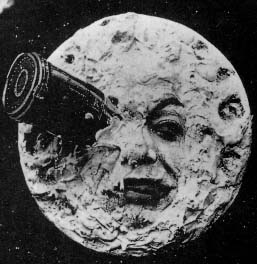
Silent movie buffs and students of the arts will recognize that name. He made hundreds of silent movies, some of the earliest ever made. If you’ve ever seen clips showing the jerky and stained scene of a scientist firing a large bullet-shaped capsule to the moon, where it lodges into the eye of the man in the moon, that’s his work.
The movie accurately describes most of the real film-maker’s plight. The only thing not factual is the bit about the boy and his broken automaton.
Man reluctantly helps boy, boy helps man, boy has a crush on the man’s god-daughter, etc. Inevitable, heart-warming happy ending ensues.
In the meantime, the transparent comic relief, Sacha Baron Cohen, three-stooges his way through the movie along with the real scene-stealer, his patient and long suffering Doberman, Max.
This may sound like I didn’t care much for the movie. This would be mostly incorrect. This Scorsese work is visually stunning. The giant gears, steam venting, slender utilitarian spiral staircases, the large but delicate clockworks indicative of the period and place filmed with a subtle sepia tone are brilliant and engrossing. Originally shot in 3-D, the film in a modern 3-D capable theater I imagine, would be even more so. I personally don’t care for movies in 3-D, they make my head hurt. I prefer my movies the same way I prefer most women, with very few dimensions and silent, whenever possible.
The acting of the lead cast is splendid, even the kids did a fine job. I was a bit perturbed by the background players, they seemed to be barely-believable stereotypical and overly-caricatured French fops as if yanked from a Pepe LePew cartoon.
The story, though based somewhat around a real time, place and person, is far more about the visual appeal than the actual story and it is very, very successful on that front.
It is long, plan on an intermission or two, especially if you have dogs or middle-aged men that need to go out frequently. Though I can’t say I loved the movie, it was a fine escape and certainly not awful, the boxed wine sort of helped.
If you have a good TV and Blu-Ray player, you’ll probably enjoy it much more than you would on smaller, lower resolution devices.
Give it a shot, let me know what you think!
Give it a shot, let me know what you think!
Feb 6, 2012
On DVD Now: "Atlas Shrugged" Part 1
http://www.amazon.com/Atlas-Shrugged-Part-Edi-Gathegi/dp/B005N4DP1E
Spoilers!
I read the massive book about fifteen years ago. At 1200+ pages that’s no small feat. To be completely honest, I started reading it then checked out the audio version from the library and listened to it over the course of a month or so. I own a copy of the book just in case.
It also bears noting that at that time I was a card-carrying, ballot-listed Libertarian, as well as chairman of the county’s Libertarian Party. So you could say I am, or at least was, sympathetic to much of the Ayn Rand classic. I got it. I understood what she was trying to say and for the most part agreed. (I’ve mellowed a little since, though ‘Libertarian’ still more accurately describes my overall political philosophy than other available labels.)
I liked the book a lot. Sure it labored a little, it was quite dated, and the ‘strong’ female lead still fell into the ‘princess in need of rescue by a strapping, powerful male’ role, but like I said, it was a bit dated. After all, the heroine runs a railroad and her ally runs a steel mill. In the 50’s these industries seemed to be all-powerful, quite unlike the archaic, rusting relics they are today.
Those things aside, the story was still a good one. Ever-increasing, well-intentioned, socially-sensitive manipulation of big industries by the U.S. Government led to the crumbling of industrial empires, with the side effect of the industrialists cashing out and heading for, for, well that isn’t revealed in the first part. Needless to say, with motivation for success stifled by government fiat, the industrialists and empire builders stopped even trying and disappeared to parts unknown.
The last few still trying, Dagney Taggert with her railroad, and steel-man Hank Reardon team up with oilman Ellis Wyatt to create an upgraded railroad line made of a new metal from Reardon, to be used by Wyatt to ship his precious product. Even more laws and taxes are passed to ‘protect’ smaller, less efficient business and unions, effectively rendering the new industrial alliance unprofitable, illegal, allegedly unsafe and downright evil.
At the end of part one, Wyatt sets his oil fields ablaze and leaves a foreboding message “I am leaving it as I found it. Take over. It's yours."
It takes the book several hundred pages to cover part one, the movie version takes less than two hours.
The book is at many points plodding. Lots and lots of dialog about goals and dreams and politics and philosophy. This works well in the book because Rand knew she was not preaching to the choir, she had to take the reader from sub-zero and get them to take the side of what otherwise would be considered too-beautiful, uber-wealthy, self-centered, profit-motivated industrialists. No small chore even then, but over the course of hundreds of pages, you actually start growing sympathetic to at least a few of the ‘one percent.’
Movie version: Fail.
There’s simply not enough time, especially in this current political/economic climate. It’s kind of like the old TV series ‘Dallas' but written as if the producers wanted us to imagine J.R. in all his glory, as the good guy. It's a tough sell.
Any story where the writers fail to get the audience to identify or sympathize with the protagonist is doomed to failure.
Sometimes good actors can pull it off. Take for example the STARZ TV Series ‘Boss’. In that series the Mayor of Chicago, played perfectly by Kelsey Grammer, is a corrupt, evil and brutal tyrant of a man, and we love him for it. We don't like what he does, or why he does it, but we sure wish we had the nads to be as confident and driven. Going further back, we loved Archie Bunker even though he had virtually no good qualities. Good writing, great acting can sometimes make it work.
Ayn Rand handled it slowly, a little at a time, gradually building up the characters to a point where we eventually sided with them. The movie fails completely to do this due to the truncation of the story for the minimalized screenplay and the fact that the actors themselves are just not at all convincing.
The movie’s cast is a who’s who of veritable unknowns. The only actor I recognized on sight was Dagny’s assistant (played by Edi Gathegi) who had a seven or eight episode arc on the TV series ‘House’ as a young, black, Mormon doctor trying to become part of the loveable curmudgeon’s diagnostic team. Everyone else in the cast I looked up and found them only in TV shows or movies I’d never seen, or on a single episode of ‘Law and Order’ or some other minor role. This is not always a bad thing, sometimes a fresh face can define a role, in this case however, the cast was just weak. They looked and sounded bored, stiff, completely lacking in energy. Angel picked up on this just listening to snippets from the other room: ”It sounds like a school play.”
To update the book, (written in the 1950's) for the screen (now set in 2016), We are told that gasoline, because of global turmoil and federal economic and environmental legislation, is thirty seven dollars per gallon, which means that rail is back as a viable and important mode of transportation for goods and people. Okay, I’ll buy that, I filled up my tank this morning. Back in the 40’s and 50’s when Rand was writing the book, people still rode on trains, they expected modern chemistry to solve all problems, and America was in constant fear of godless, anti-economic communists, so this whole thing was a much easier sell then.
Then we see the new train on the new track. OMG! The special effects were horrible! Nothing about the train roaring down the track looked remotely real. The scaling, perspective and speed were all way off. And it was just a train, not a planet-sized starship or hideous space alien. This gave the whole film the look and feel of a bad TV movie,(remember the 1979 series 'Supertrain'?) as bad as another low-budget, direct-to-TV movie we watched a couple of weeks ago called ‘Swamp Volcano’. (Also as bad as it sounds) Clay-mation would have been an improvement over the special effects employed in this film.
This film made me think that maybe “Atlas Shrugged” just cannot be successfully adapted to the big screen. Even Ayn Rand herself was reluctant to allow it, worried that her big picture would be sacrificed adapting it to the big screen. The biggest, most vital concepts in the classic book, and in fact the heroes themselves, are cerebral and philosophical, not physical or emotional.
Or maybe the producers of the film simply weren’t up to the task. The director, hired for the job just nine days before filming began, was Paul Johansson, who has very few ‘director’ credits and his acting credits are primarily in only moderately successful roles and films. Why he was chosen for such a daunting task is unknown to me.
The screenplay is weak. Once again though, a nearly impossible task of converting dated and complex cerebral, political and economic themes to a visual medium.
Roger Ebert said of this film: "So OK. Let’s say you know the novel, you agree with Ayn Rand, you’re an objectivist or a libertarian, and you’ve been waiting eagerly for this movie. Man, are you going to get a letdown. It’s not enough that a movie agree with you, in however an incoherent and murky fashion. It would help if it were like, you know, entertaining?"
And that’s where I fall. I awaited eagerly and was, without exception, on every level, let down.
As for those who have not read the book, or have no stomach for even a whiff of objectivism or libertarianism, this film will only prove even more insufferable. In fact, because of the poor quality of the casting, the awkward screenplay and the mangled manhandling of the core message, I can’t imagine a single demographic that would enjoy this pig.
Summary: Don’t bother. If anything, pray for the immediate demise of the proposed parts two and three.
Dec 24, 2011
Movie Time: The Girl with the Dragon Tattoo
No spoilers!
This was my birthday present this year, I got to choose a movie.I met up with Angel and Adam in Fenton after I got off work. There wasn’t a big crowd at the cine-plex, Thursday I guess, being a light night.
I’d read the book earlier this year, or maybe it was last year, the entire trilogy actually. It was long ago enough that I couldn’t recall exactly at what point in the epic trilogy storyline each of the three books started or ended. I easily recalled events, characters and plots, but not the exact chronology. Adam and Angel had not read any of the books. I was really curious about what they might think of it.
Another thing that I should point out, I only see movies in a theater rarely, one per year or less. It takes a really, really potentially good movie to get me to sit in a theater for several hours. Most movies I’m willing to wait for the pay-per-view or DVD. That way I can pause, replay, set the volume, etc. I really don’t like theaters.
That being said. . .
The opening credits/theme was James Bond-ish, bold music, a slime covered woman dancing seductively, not really relevant to the story at all, stylish, but too long. By this time we’d already suffered through several ads, a half dozen previews, and various warnings about cell phone usage. I wanted to get on with it. (Where’s fast-forward when you really need it?)
The movie’s actual opening scenes set the time and place well, Sweden, winter, cold, dark. The two protagonists, Lisbeth and Mikael don’t interact with each other for nearly the first hour of the movie. We follow them individually though. This is in line with the book. We quickly gather that Lisbeth is a troubled, damaged, but a brilliant freak abused by just about every man that has ever been part of her life. She has a certain moral code, but it’s one of her own making, and one that is certainly honed from a very rough life.
Mikael steps aside from his co-publisher role at Millennium Magazine after a scandal involving stories he wrote about a wealthy industrialist. We’re told he was set up, deliberately given bad information, but public trust in journalism is fickle. Another damaged, vulnerable hero. This part is covered very, very quickly and not in depth. The book had the luxury of explaining it in more understandable detail.
He is hired by an old, retired industrialist, a foe of the one that messed up Mikael’s career. The plot is laid out. A teenage member of the wealthy Vanger family went missing several decades prior, the old man suspects someone in the family killed her and disposed of her body while they were living on or visiting the isolated island compound that day. The Vangers are a completely dysfunctional lot, former Nazi’s and sons/daughters of Nazis and all hermits, nags, wife-beaters and asses. Completely unlikable people.
This is essentially a locked room mystery as the girl disappeared while the island was even more isolated than usual due to a truck accident that blocked the only bridge to the mainland for much of the day of her disappearance.
Meanwhile Lisbeth’s social worker/guardian suffers a stroke, and her case is handed over to a cruel, abusive bureaucrat. In short time he forces Lisbeth to perform increasingly cruel and violent sex acts in exchange for her allowance.
Here’s the next thing you need to know. Though this storyline is in synch with the book, the book’s description of these acts is tempered by brevity. The book leaves the reader to imagine most of it. The movie SHOWS us the acts in graphic detail. If you are at all squeamish about nudity and sexual violence on the screen, you will definitely squirm during these scenes. And there’s more than one of them.
Personally I think this could have been handled much, much better. This was too overt, too violent. The point could have been made with a lot less flesh and blood. I’m pretty liberal minded about this sort of thing, but even for me much of it was simply awkward, gratuitous, and worse, just plain unnecessary.
What took several chapters in the book, Vanger telling the story of his damaged family, one by one, took up only a few minutes in the movie. I don’t know how they could have done it much differently though, the cast of characters in the book is nearly as cumbersome as that in ‘War and Peace’. Add to that the names being Scandinavian, Germanic, etc. the poor, typical American brain doesn’t quite grasp them all as well as if they were Smiths, Jones, etc. I found that in the book there were several names with peculiar dots and lines over some of the letters that I could not even mentally pronounce. I asked Angel about this segment and she said she eventually tuned it all out, finding it impossible to keep up with all the names and who was the son/daughter of whom.
In all though, the movie doesn’t stray much from the book. The visuals are all stunning, the musical score very good, if not quirky. Some of the background narrative, as I pointed out earlier, is sped up to a dizzying, confusing pace. Even though the movie is nearly three hours along, a lot is left out, or incomplete in context, by necessity. (in the book we know more about the golf club that Lisbeth uses as a weapon.) The book was very detailed and precise. In the book there were several plot line distractions to keep the reader from guessing the outcome. Some of these, like the whole Nazi story line, were trimmed in the screenplay to the point where it probably could have been left out altogether in the movie. Novels, especially good ones, do not adapt very well to the big screen. Short stories and novellas work much better. Fewer characters, fewer subplots, etc. In this case this movie could have completely done without several family members. The last twenty minutes or so, dealing solely with the destruction of the industrialist that disgraced Mikael, could have been taken out and left for a sequel. As this movie goes we find out who the bad guy is and what happens to him, which is what we are actually led to care about, well before the movie ends. As I recall in the book, these two plots were more parallel, with both ending at about the same point at the end of the book, I could be wrong. But the movie deals primarily, with only a few exceptions, with the missing girl, then comes back to the industrialist only after that plot line is complete.
Summary:
I absolutely loved this movie. The things I point out, like the gratuitous sex, only actually take up a small fraction of it and can be put into that perspective. The rushing through of certain areas is completely tolerable, if you’ve read the book.
So that’s what I recommend. Read the book first, then you can enjoy the ride without fretting the details as to which mumbled line of thick-accented dialog is crucial and which isn’t. Reading the book will NOT spoil this movie. The movie actually takes you there, puts you in the cold dark Nordic air, the damp back alleys, the torture pit. It gives you credible, believable face and voice to the characters, as the casting in this thing was absolutely dead-on.
Angel and Adam said they enjoyed it, but I got the impression they didn't quite catch some of the nuances, the bits that made the book a superstar. I couldn't get them to say much bad about it at all, except for the slight discomfort as mom, dad and son sat together during some really, really graphic sex scenes. Angel was pleased to find out that there are plans to bring the rest of the trilogy to the big screen. She's got a dark side that she pretty much keeps to herself, but she does enjoy a good dark story about really evil people. She scares me sometimes.
Though with certain caveats, I recommend it. It's the best movie I've seen in a theater this year. Okay, it was also the only movie I sat through in a theater this year, but still I thoroughly enjoyed it. However, it would be just as good on a living room flatscreen , three hours is a really long time without an 'intermission'.
This was my birthday present this year, I got to choose a movie.I met up with Angel and Adam in Fenton after I got off work. There wasn’t a big crowd at the cine-plex, Thursday I guess, being a light night.
I’d read the book earlier this year, or maybe it was last year, the entire trilogy actually. It was long ago enough that I couldn’t recall exactly at what point in the epic trilogy storyline each of the three books started or ended. I easily recalled events, characters and plots, but not the exact chronology. Adam and Angel had not read any of the books. I was really curious about what they might think of it.
Another thing that I should point out, I only see movies in a theater rarely, one per year or less. It takes a really, really potentially good movie to get me to sit in a theater for several hours. Most movies I’m willing to wait for the pay-per-view or DVD. That way I can pause, replay, set the volume, etc. I really don’t like theaters.
That being said. . .
The opening credits/theme was James Bond-ish, bold music, a slime covered woman dancing seductively, not really relevant to the story at all, stylish, but too long. By this time we’d already suffered through several ads, a half dozen previews, and various warnings about cell phone usage. I wanted to get on with it. (Where’s fast-forward when you really need it?)
The movie’s actual opening scenes set the time and place well, Sweden, winter, cold, dark. The two protagonists, Lisbeth and Mikael don’t interact with each other for nearly the first hour of the movie. We follow them individually though. This is in line with the book. We quickly gather that Lisbeth is a troubled, damaged, but a brilliant freak abused by just about every man that has ever been part of her life. She has a certain moral code, but it’s one of her own making, and one that is certainly honed from a very rough life.
Mikael steps aside from his co-publisher role at Millennium Magazine after a scandal involving stories he wrote about a wealthy industrialist. We’re told he was set up, deliberately given bad information, but public trust in journalism is fickle. Another damaged, vulnerable hero. This part is covered very, very quickly and not in depth. The book had the luxury of explaining it in more understandable detail.
He is hired by an old, retired industrialist, a foe of the one that messed up Mikael’s career. The plot is laid out. A teenage member of the wealthy Vanger family went missing several decades prior, the old man suspects someone in the family killed her and disposed of her body while they were living on or visiting the isolated island compound that day. The Vangers are a completely dysfunctional lot, former Nazi’s and sons/daughters of Nazis and all hermits, nags, wife-beaters and asses. Completely unlikable people.
This is essentially a locked room mystery as the girl disappeared while the island was even more isolated than usual due to a truck accident that blocked the only bridge to the mainland for much of the day of her disappearance.
Meanwhile Lisbeth’s social worker/guardian suffers a stroke, and her case is handed over to a cruel, abusive bureaucrat. In short time he forces Lisbeth to perform increasingly cruel and violent sex acts in exchange for her allowance.
Here’s the next thing you need to know. Though this storyline is in synch with the book, the book’s description of these acts is tempered by brevity. The book leaves the reader to imagine most of it. The movie SHOWS us the acts in graphic detail. If you are at all squeamish about nudity and sexual violence on the screen, you will definitely squirm during these scenes. And there’s more than one of them.
Personally I think this could have been handled much, much better. This was too overt, too violent. The point could have been made with a lot less flesh and blood. I’m pretty liberal minded about this sort of thing, but even for me much of it was simply awkward, gratuitous, and worse, just plain unnecessary.
What took several chapters in the book, Vanger telling the story of his damaged family, one by one, took up only a few minutes in the movie. I don’t know how they could have done it much differently though, the cast of characters in the book is nearly as cumbersome as that in ‘War and Peace’. Add to that the names being Scandinavian, Germanic, etc. the poor, typical American brain doesn’t quite grasp them all as well as if they were Smiths, Jones, etc. I found that in the book there were several names with peculiar dots and lines over some of the letters that I could not even mentally pronounce. I asked Angel about this segment and she said she eventually tuned it all out, finding it impossible to keep up with all the names and who was the son/daughter of whom.
In all though, the movie doesn’t stray much from the book. The visuals are all stunning, the musical score very good, if not quirky. Some of the background narrative, as I pointed out earlier, is sped up to a dizzying, confusing pace. Even though the movie is nearly three hours along, a lot is left out, or incomplete in context, by necessity. (in the book we know more about the golf club that Lisbeth uses as a weapon.) The book was very detailed and precise. In the book there were several plot line distractions to keep the reader from guessing the outcome. Some of these, like the whole Nazi story line, were trimmed in the screenplay to the point where it probably could have been left out altogether in the movie. Novels, especially good ones, do not adapt very well to the big screen. Short stories and novellas work much better. Fewer characters, fewer subplots, etc. In this case this movie could have completely done without several family members. The last twenty minutes or so, dealing solely with the destruction of the industrialist that disgraced Mikael, could have been taken out and left for a sequel. As this movie goes we find out who the bad guy is and what happens to him, which is what we are actually led to care about, well before the movie ends. As I recall in the book, these two plots were more parallel, with both ending at about the same point at the end of the book, I could be wrong. But the movie deals primarily, with only a few exceptions, with the missing girl, then comes back to the industrialist only after that plot line is complete.
Summary:
I absolutely loved this movie. The things I point out, like the gratuitous sex, only actually take up a small fraction of it and can be put into that perspective. The rushing through of certain areas is completely tolerable, if you’ve read the book.
So that’s what I recommend. Read the book first, then you can enjoy the ride without fretting the details as to which mumbled line of thick-accented dialog is crucial and which isn’t. Reading the book will NOT spoil this movie. The movie actually takes you there, puts you in the cold dark Nordic air, the damp back alleys, the torture pit. It gives you credible, believable face and voice to the characters, as the casting in this thing was absolutely dead-on.
Angel and Adam said they enjoyed it, but I got the impression they didn't quite catch some of the nuances, the bits that made the book a superstar. I couldn't get them to say much bad about it at all, except for the slight discomfort as mom, dad and son sat together during some really, really graphic sex scenes. Angel was pleased to find out that there are plans to bring the rest of the trilogy to the big screen. She's got a dark side that she pretty much keeps to herself, but she does enjoy a good dark story about really evil people. She scares me sometimes.
Though with certain caveats, I recommend it. It's the best movie I've seen in a theater this year. Okay, it was also the only movie I sat through in a theater this year, but still I thoroughly enjoyed it. However, it would be just as good on a living room flatscreen , three hours is a really long time without an 'intermission'.
Subscribe to:
Posts (Atom)